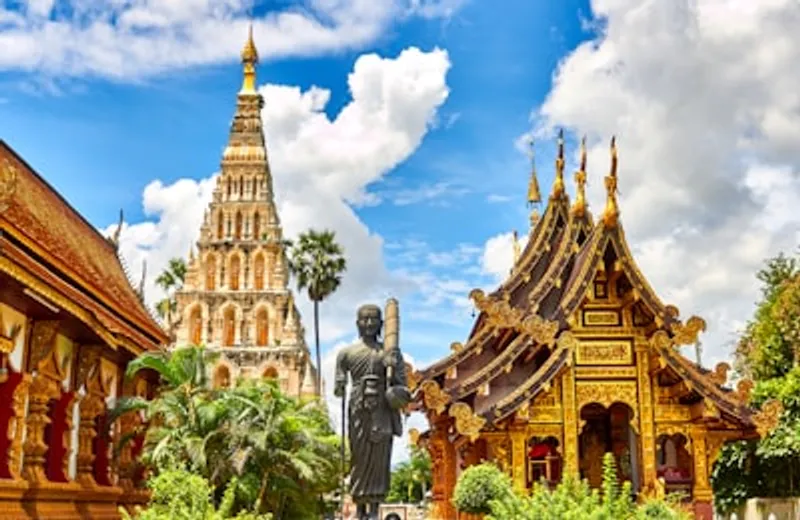
Chiang Mai is often called the “Rose of the North,” and its old city is home to over 30 Buddhist temples packed within a compact, moat-enclosed square. The sheer density means you can easily visit several in a single morning on foot or by bicycle. Among the most celebrated is Wat Phra Singh, located at the western end of Ratchadamnoen Road. This 14th-century temple houses the Phra Singh Buddha, one of northern Thailand’s most revered images, and its Lanna-style architecture — with layered, swooping rooflines and intricate gold-and-red lacquerwork — is among the finest you will find anywhere in the country. Arrive early in the morning to enjoy the grounds in relative peace before tour groups descend.
Wat Chedi Luang sits near the center of the old city and is dominated by a massive, partially ruined brick chedi that once stood nearly 80 meters tall before an earthquake toppled its upper section in 1545. The scale of the remaining structure is still awe-inspiring, and the naga staircases flanking the eastern stairway are beautifully carved. The temple grounds also host one of Chiang Mai’s most popular Monk Chat sessions, held daily in the late afternoon, where novice monks practice their English with visitors. It is a genuinely enriching exchange — you can ask about Buddhist philosophy, daily monastic life, or Thai culture, and the monks are happy to answer candidly.
Wat Chiang Man is the oldest temple in the city, founded by King Mengrai himself in 1296 when he established Chiang Mai as the capital of the Lanna kingdom. Its chedi, supported by rows of stone elephants, is a distinctive landmark. Inside the main viharn you will find two highly venerated Buddha images: the marble Phra Sila and the tiny crystal Phra Satang Man. The temple sees fewer visitors than Wat Phra Singh or Wat Chedi Luang, making it a quieter, more contemplative stop.
No temple tour of the Chiang Mai area is complete without a trip up to Wat Phra That Doi Suthep, perched on the mountainside about 15 kilometers west of the old city. A 309-step naga staircase (or a funicular for those who prefer) leads to a glittering gold chedi with panoramic views over the city and surrounding valley. Songthaews run regularly from the old city to the base of the temple for about 40-60 THB per person each way, and the trip takes roughly 30 minutes. Try to visit on a clear day for the best views — during the cool season months of November through February, mornings tend to be particularly crisp and clear.
The best strategy is to start early, around 7:00 or 8:00 AM, when temperatures are cooler and crowds are thin. Most temples within the old city are free to enter or ask for a small donation of 20-40 THB. Wat Phra That Doi Suthep charges a 30 THB entrance fee for foreigners. Budget half a day for the old city temples and a separate half-day excursion for Doi Suthep, especially if you want to combine it with a stop at the nearby Hmong hill-tribe village of Doi Pui.